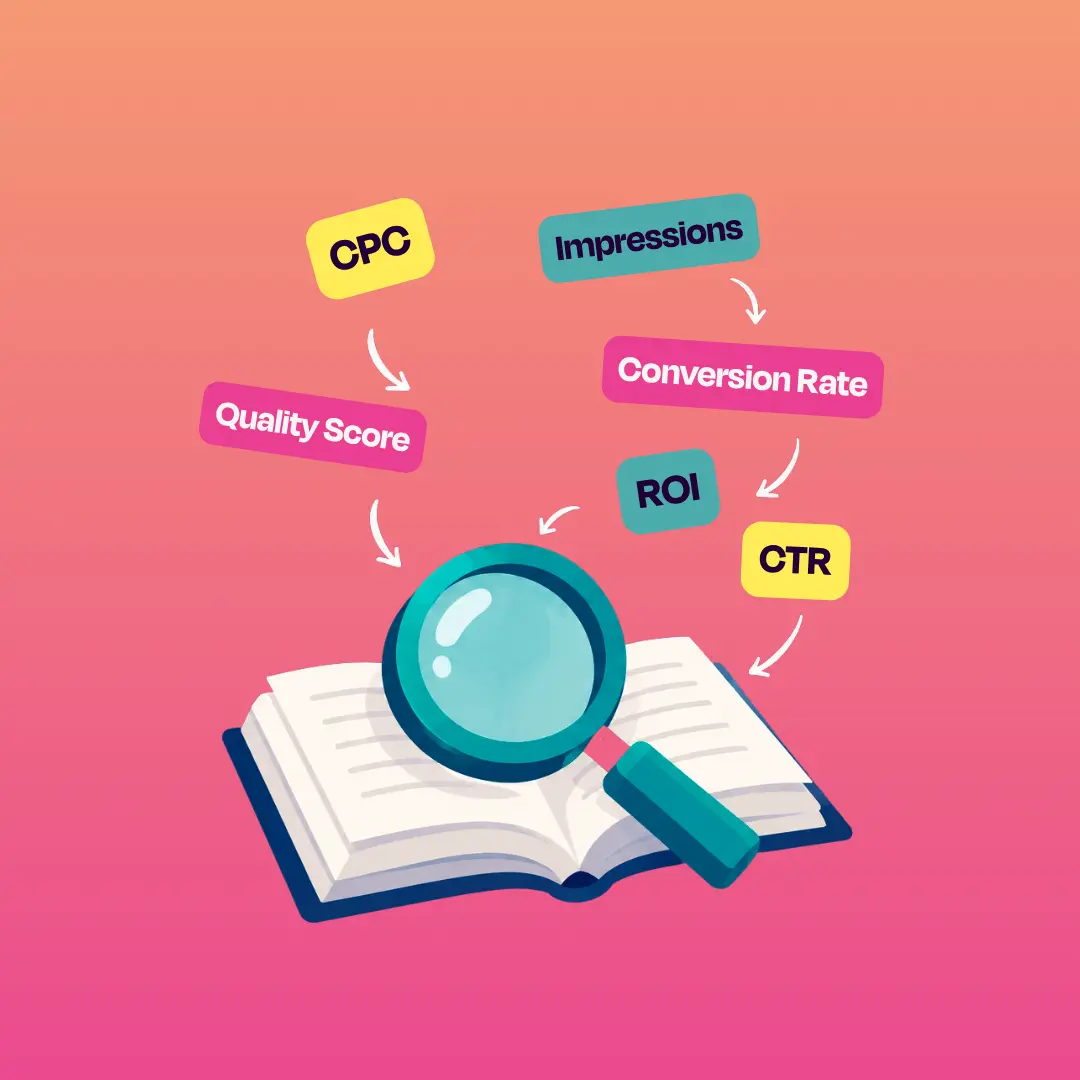
Talking about PPC can feel like learning a new language, especially when platforms rename features or new terms pop up every few months. You don’t need to know every setting inside Google Ads, because really, that’s what PPC specialists are for. However, there are terms you should know to understand where your budget is going and what your results actually mean.
To help, we’ve put together a PPC glossary with the terms you’re most likely to hear. If you’re after the organic side of search, our SEO glossary has you covered.
Jump ahead to:
Section 1 – The PPC basics
1. Ad rank
Ad rank decides what position your ad appears on the page. Google calculates it using your keyword bid, ad quality score and landing page, which means the highest bidder doesn’t automatically win the top spot.
2. Clicks
A click is counted each time someone clicks on your ad, and in most PPC campaigns, it’s what you pay for.
3. CPC
CPC stands for cost per click. It’s the amount you pay each time someone clicks your ad, and it varies depending on how many other businesses are bidding on the same search.
4. Conversions
A conversion is an action you want people to take after clicking your ad, such as submitting an enquiry, booking a call or buying a product. You decide what counts as a conversion.
5. Conversion tracking
Conversion tracking records when someone completes a valuable action after clicking your ad, like a form fill or purchase. It’s how both you and Google know what’s working.
Further reading: Why conversion tracking matters for paid ads.
6. CTR
CTR stands for click-through rate. In PPC, it’s the percentage of people who click your ad after seeing it. A strong CTR shows your ad is relevant to what people are searching for.
7. Impressions
An impression is counted each time your ad is shown. Impressions measure visibility, but on their own, they don’t tell you much about performance, as they don’t take into account landing page visits or actions.
8. Keywords
Keywords are the words and phrases you bid on to tell Google which searches your ads should appear for. For example, a software company might bid on “contract management software”.
9. Match types
Match types control how closely a users search term needs to match your target keyword for your ad to show:
- Broad match: Your ad can show for searches similar to or related to your keyword.
- Phrase match: Your ad shows for searches that include the meaning of your keyword.
- Exact match: Your ad shows for searches with the same meaning or intent as your keyword.
10.Negative keywords
Negative keywords stop your ads from showing for searches you don’t want to pay for. For example, adding “jobs” or “free” as negative keywords keeps job seekers and bargain hunters from spending your budget. Like normal keywords, negatives have match types:
- Broad match: Blocks searches that contain all of your negative words, in any order.
- Phrase match: Blocks searches that contain your negative words in the same order.
- Exact match: Only blocks searches that match your negative keyword exactly.
11. PPC
PPC stands for pay-per-click. It’s a type of online advertising where you pay each time someone clicks your ad, used across platforms like Google, ChatGPT, Bing and LinkedIn Ads.
12. Quality score
Quality score is Google’s 1 to 10 rating at keyword level, based on expected CTR, ad relevance and landing page experience. A low score usually means your ad or page isn’t matching what people are searching for.
13. Search term report
The search term report shows the actual searches that triggered your ads. It helps you spot irrelevant searches, identify new keyword opportunities and add negative keywords where needed.
Section 2 – Bidding & budgets
Where your money goes and how Google decides to spend it.
14. Impression share
Impression share is the percentage of times your ad was shown compared to how many times it could have been shown. Google also tells you if you lost out due to budget or ad rank.
15. Learning phase
The learning phase is the period after a new campaign or big change while Google’s bidding adjusts. It typically lasts two weeks, or longer for campaigns with fewer conversions, so patience is key before making any big alterations during the learning phase.
16. Limited by budget
“Limited by budget” means a campaign is regularly hitting its daily budget early. You’re missing out on potential clicks, but tighter targeting can be an alternative fix rather than spending more.
17. Manual CPC
Manual CPC (cost per click) is a bidding strategy where you set your own maximum bid for each keyword. It gives you full control over spend but without the help of Google’s automation.
18. Maximise clicks
Maximise clicks is an automated bidding strategy that aims to get as many clicks as possible within your budget. It’s useful for building traffic, but it doesn’t consider whether clicks turn into leads.
19. Conversion Value
Conversion value is the monetary value you give each conversion, such as the revenue from a sale or the estimated worth of a lead. It helps Google understand which conversions matter most, rather than treating every one the same.
20. Maximise conversions
Maximise Conversions is a Smart Bidding strategy that uses Google’s AI to adjust bids in each auction and get as many conversions as possible. It works best when your primary conversion actions reflect the business goals, such as qualified leads or sales.
21. Smart bidding
Smart bidding is the umbrella term for Google’s automated bidding strategies. It’s one of the biggest ways AI is changing Google Ads, adjusting bids for every auction based on signals like device, location and time of day.
22. CPA & Target CPA
CPA stands for cost per acquisition, which is the average amount you pay for each conversion. Target CPA (tCPA) is an optional setting where you tell Google the CPA you want to achieve, and Google then tries to get as many conversions as possible around that cost.
23. ROAS & Target ROAS
ROAS stands for return on ad spend, which is the revenue you earn for every pound spent on ads. Target ROAS (tROAS) works like Target CPA, but for revenue, setting the return on ad spend you want. This is the most popular strategy in ecommerce, as it more closely aligns with other metrics like profit.
Section 3 – Campaign types
Google Ads offers several campaign types, each built for a different goal. Here are the ones you’ll come across the most.
24. Demand Gen
Demand Gen (or generation) campaigns show visual ads across YouTube, Discover, Gmail and the Display Network. They reach people while they’re browsing rather than searching, helping build interest before they’re ready to buy.
25. Local Services Ads
Local Services Ads (LSAs) appear at the very top of Google for local service searches like “roofer near me”. You pay per lead rather than per click, and reviews play a big part in performance.
26. Performance Max (PMax)
PMax runs across all of Google’s channels from one campaign, using AI to decide where your ads show. It’s the campaign type behind our PMax success for Westside Bathrooms. Within PMax, you’ll also hear about:
- Asset groups: Collections of headlines, images and videos grouped around a product or service.
- Search themes: Topics that help Google understand which searches are relevant to you.
27. Remarketing
Remarketing shows ads to people who have already visited your website. Because they already know you, these campaigns tend to convert well, as we saw with our Christmas campaign for a popular adventure park.
28. Search campaigns
Search campaigns are the classic text ads that appear when someone searches on Google. They’re keyword-driven and capture people actively looking for what you offer.
29. Shopping campaigns
Shopping campaigns show product ads with an image, price and shop name directly in Google results. They’re ideal for ecommerce brands, and they’re how we’ve helped clients in the aesthetics wholesale space, like LPG Clinics Wholesale, grow their online sales.
Section 4 – Ads & assets
30. A/B testing
A/B testing means running two versions of an ad or landing page to see which performs better. It’s how we found the winning creative for a London aesthetic clinic’s Black Friday campaign.
31. Ad strength
Ad strength is Google’s rating of how well your ad is set up, from “Poor” to “Excellent”. It’s a helpful guide, but it doesn’t directly affect where your ad ranks.
32. Assets
Assets, previously called extensions, add extra information to your ads, such as sitelinks, callouts, phone numbers and images. They make your ad bigger and usually improve CTR.
33. Landing page experience
Landing page experience is how relevant and useful your page is to the person who clicked. If your ad promises one thing and the page delivers another, people leave, which is why conversion rate optimisation matters.
34. Responsive search ads
Responsive search ads (RSAs) are the standard Search ad format. You write up to 15 headlines and four descriptions, and Google tests different combinations to find what works best.
Section 5 – Tracking & measurement
Without accurate tracking, you’re spending money blind. Tracking is a technical skill, but these are the terms you should recognise.
35. Attribution
Attribution is how credit for a conversion is shared across the ads someone interacted with before converting. Google Ads uses data-driven attribution by default.
36. Consent Mode
Consent Mode tells Google whether a visitor has accepted cookies, so its tags can adjust how they track. The latest version, Consent Mode v2, is essential for UK and EU advertisers.
37. Conversion rate (CVR)
Conversion rate is the percentage of clicks that result in a conversion. If 100 people click your ad and five convert, your conversion rate is 5%.
38. CPA
CPA stands for cost per acquisition. It’s the average amount you pay for one conversion, worked out by dividing your spend by your conversions.
39. Enhanced Conversions
Enhanced Conversions is a Google Ads feature that makes your conversion tracking more accurate. It matches details people share with you, like an email address, to their Google account, so more conversions get linked back to your ads.
40. GA4
GA4 (Google Analytics 4) is Google’s website analytics platform. It tracks how people find and use your site across every channel and can be linked to Google Ads.
41. GCLID
GCLID stands for Google Click Identifier, a unique code added to your URL when someone clicks your ad. Capturing it when you integrate your CRM with your ads connects each lead back to the ad that drove it.
42. Google Merchant Center
Google Merchant Center is a free tool that acts as the link between your online shop and Google. You upload your product details there, Google checks them against its policies, and approved products can then appear in Shopping ads and PMax campaigns.
43. Google Tag Gateway
Google Tag Gateway lets your tracking tags load through your own website domain rather than Google’s. It reduces data loss and makes measurement more reliable.
44. Google Tag Manager
Google Tag Manager (GTM) is a free tool for adding and managing tracking codes on your website without editing the site’s code each time.
45. Offline conversions
Offline conversions are results that happen away from your website, like a signed contract. Importing them into Google Ads lets it optimise towards real sales rather than just form fills.
46. Primary & secondary conversions
Primary conversions are the actions Google optimises bidding towards, like a form submission. Secondary conversions are tracked for reporting only, like a brochure download.
Section 6 – AI & new platforms
PPC has changed more in the last two years than in the decade before it. Here’s what you need to know.
47. AI Max for Search
AI Max is a set of AI features you can switch on within Google Search campaigns. It expands which searches you match to and tailors your ad copy and landing pages to each one.
48. Audience signals
Audience signals are hints you give Performance Max about your ideal customers, like customer lists or website visitors. They guide Google’s AI rather than acting as strict targeting.
49. ChatGPT Ads
ChatGPT Ads appear alongside conversations in ChatGPT, matched to the context of what users are asking. They launched in the UK in August 2026, and you can read everything we know so far about ChatGPT Ads in our guide.
50. Context hints
Context hints are short descriptions added to ChatGPT ad groups to help OpenAI understand when your ad is relevant. They’re not keywords, so think of them as a briefing rather than a rule.
Need help with your PPC strategy?
At Trio, we manage Google Ads, paid social and ChatGPT Ads campaigns designed to generate quality leads and sales, not just clicks. If you’re looking to make sense of your ads or take the next step, our team is here to help.
FAQs
Yes, when it’s managed properly. PPC puts you at the top of search results straight away, in front of people actively looking for what you offer. With AI Overviews taking up more space in search results, it’s also one of the most reliable ways to stay visible, especially when PPC, SEO, and AI work together.
The biggest shift has been automation, with AI now handling bidding, targeting and even ad copy through campaigns like Performance Max and Advantage+. New platforms have also arrived, with ChatGPT Ads launching in the UK in 2026. You can read more about how AI is changing Google Ads in our guide.
- Track the conversions that matter, not just any action on your site.
- Review your search terms report and add negative keywords regularly.
- Match your ad copy closely to your landing pages.
- Give automated bidding time to learn before making big changes.
- Test new headlines, images and offers often.
- Feed lead quality back from your CRM so the platforms optimise towards real sales.
Setting up a campaign can be simple, but running a profitable one is a different story. It’s easy to waste budget on irrelevant searches or let automation chase low-quality leads, which is where a PPC agency earns its keep. It’s how we’ve generated quality B2B leads for Site Track.