
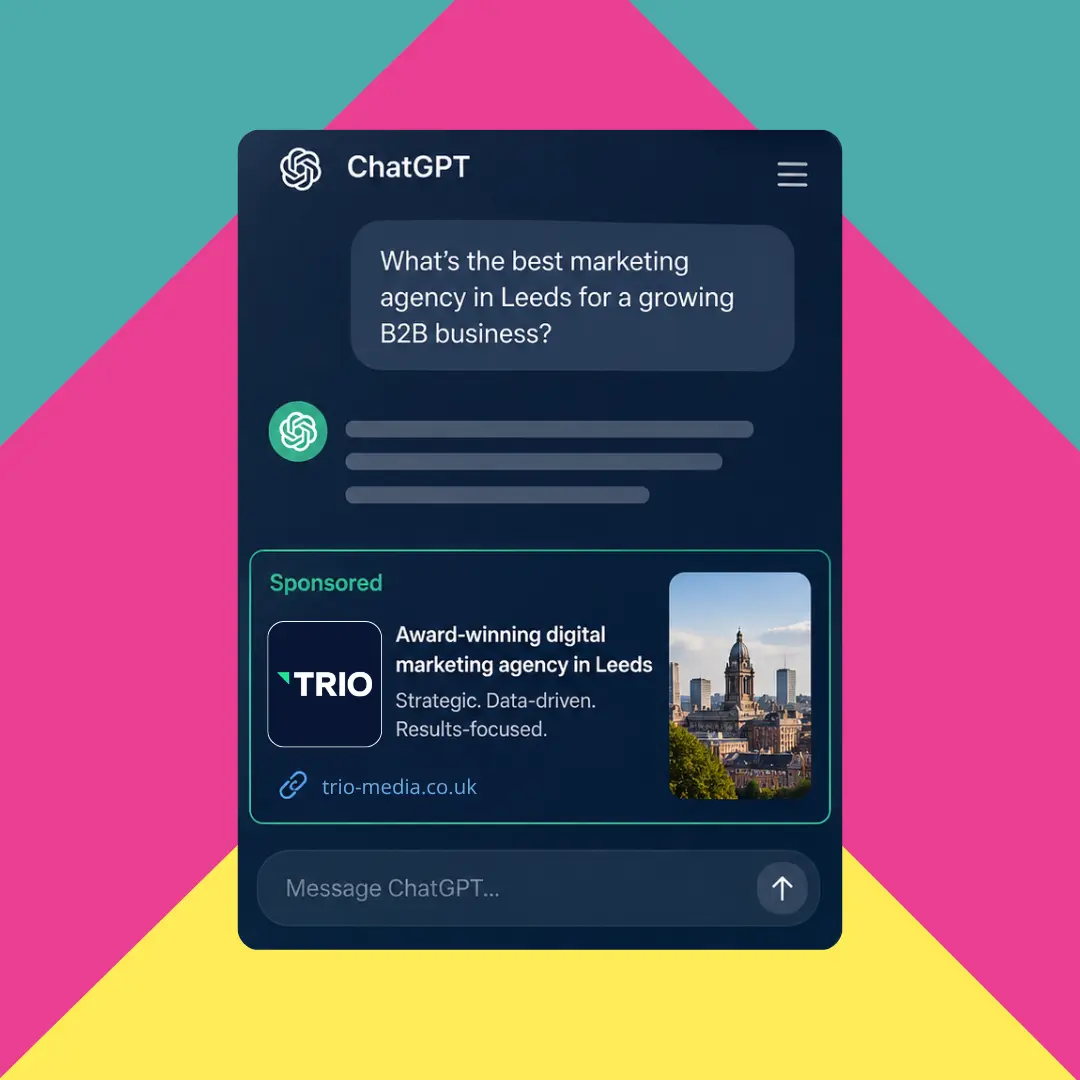
ChatGPT ads are sponsored placements that appear within OpenAI’s ChatGPT interface. These AI ads allow brands to reach users during conversational searches and AI-assisted research.
While advertising in ChatGPT remains in its early stages (piloting in the UK only in May 2026), these ads signal a shift towards conversational advertising, where brands can engage audiences while they actively seek answers, recommendations and information.
TL;DR
- ChatGPT ads are sponsored placements designed for conversational AI experiences. OpenAI launched the UK advertising pilot in May 2026.
- Ads appear only for users (over the age of 18) on the Free and Go plans. Plus, Business, Enterprise and Edu accounts will not receive ads.
- Ads within ChatGPT rely on contextual cues and conversational topics rather than traditional keyword bidding strategies.
- Targeting and measurement capabilities are still developing compared to those of platforms like Google Ads and Meta.
- Early adoption of ChatGPT ads will provide helpful learning opportunities for brands building on their AI search strategy.
- ChatGPT ads are still in their infancy – they should complement, rather than replace, existing paid media strategies.
What are ChatGPT Ads?
ChatGPT ads are paid advertising placements that appear within OpenAI’s ChatGPT platform. They aim to help brands reach users as they interact with AI through natural-language conversations.
Unlike traditional search ads, where users type short keywords into a search engine, ChatGPT users ask detailed questions and seek personalised answers. This creates a different advertising environment based on context and intent. For example, instead of searching:
“Best marketing agency Leeds”
A ChatGPT user might ask:
“What marketing agency in Leeds is best for a growing B2B business with a sales team that struggles with inbound leads?”
This conversational behaviour creates opportunities for advertisers to appear alongside highly specific user journeys. For brands already investing in AI visibility, these ads bridge the gap between organic Generative Engine Optimisation (GEO, also known as AEO or AI SEO) and traditional PPC campaigns. To understand how these channels interact, read our guide on how AI, PPC and SEO work together.
Why ChatGPT ads matter
ChatGPT advertising matters because user behaviour is changing. The developments from OpenAI, Google, Microsoft and Anthropic have now made AI assistants a primary discovery channel alongside:
- Traditional search engines
- Social media platforms
- Review websites like Trustpilot
- Online marketplaces
- Business & local directories
As AI adoption grows, marketers will need to consider how users will discover and engage with their brand within these conversational interfaces.
What will ChatGPT ads look like?
ChatGPT ads appear as distinct visual blocks beneath the main conversational response. Every sponsored placement includes specific components, such as:
- Advertiser name
- Brand logo
- A headline and short description
- A clickable destination link (landing page)
- Image asset
- A clear ‘sponsored’ disclosure label
OpenAI intentionally designed this format to maintain a positive user experience while clearly separating promotional content from organic AI responses. The brand has been clear that ads do not influence ChatGPT’s answers – so much so that ads run on a separate system to avoid shaping or altering how the chat model responds.
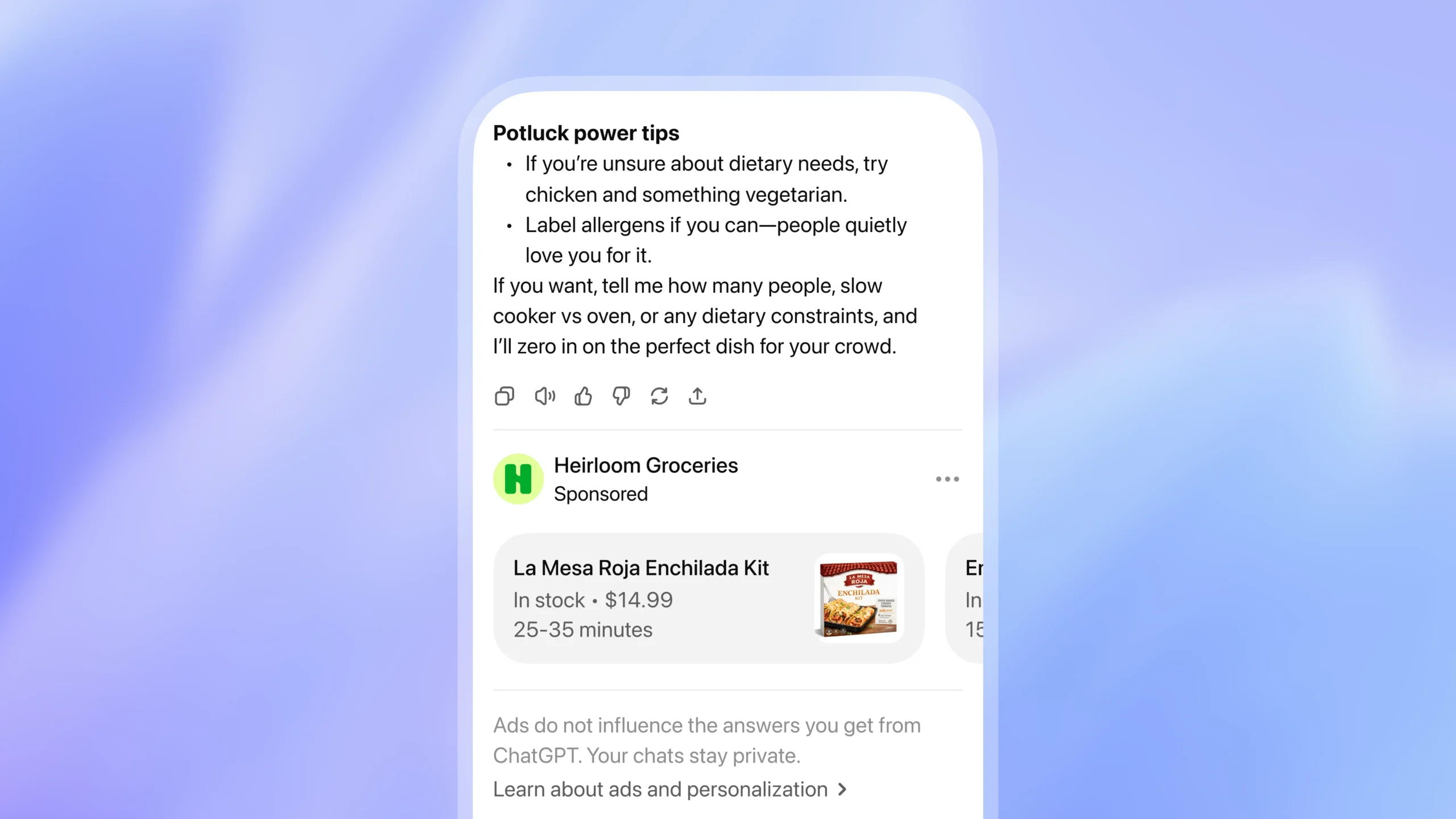
Image Source: OpenAI
How do ChatGPT ads work?
ChatGPT ads work by matching sponsored content to a user’s topic of conversation, past chats and past interactions with ads. For example, if you’re researching skincare solutions for acne, you may see ads for skincare products or cosmetic treatments at clinics.
Although OpenAI hasn’t released many details on advertising, we expect ChatGPT ads to follow a process like this:
- Process user conversational queries: The chat model analyses the user’s prompt, along with the conversation history and previous chats. With this insight, the LLM can understand what the user is trying to solve.
- Match ad context to intent: ChatGPT then matches the user’s intent to advertisers whose products or services align with the conversation. If there are multiple advertisers, the most relevant one will be shown first.
- Display sponsored content: ChatGPT provides an organic response to the query and includes a sponsored section at the bottom, without influencing its answer.
- Measure engagement: As with all ad platforms, advertisers will receive reports on ad visibility, interactions and results.
How will ChatGPT ads be targeted?
ChatGPT ads are expected to rely heavily on contextual targeting rather than traditional keyword targeting alone to determine relevance.
Advertisers can provide ‘context hints’ that outline the topics, conversations or keywords where their services or products are relevant. For example, a SaaS company offering lead-generation tools could target conversations in which users ask how to improve outbound email marketing. These hints guide ad matching but aren’t exact-match keywords. This approach aligns with modern audience behaviour and mirrors the strategies outlined in our guide to paid social and AEO-led ads.
OpenAI is clear that personal data, such as chats, chat history or personal details, is not shared with advertisers. Instead, ads are targeted purely on real-time semantic relevance, rather than user tracking, which aligns with the strict data privacy guidelines of the EU and UK GDPR.
How are ChatGPT ads different from other platforms?
ChatGPT ads differ in that they operate within conversations rather than in search results (SERPs) or social feeds.
| Platform | User behaviour | Targeting method | Intent level | Typical ad placement |
| Google Ads | Searches for information | Keywords, audiences, intent signals and AI-driven signals (Performance Max) | High | Search text ads, shopping listings, YouTube videos, Display Network banners and Discover feeds |
| Microsoft Ads | Searches for information | Same targeting options as Google Ads | High | Search text ads, Shopping listings, MSN network banners and CoPilot citations |
| Meta Ads | Browses feed content | Demographics, interests and behaviours | Medium | Feed, Stories and Reels |
| TikTok Ads | Watches feed content | Interests, engagement signals and behaviours | Medium | For You feed and video placements |
| LinkedIn Ads | Consumes professional content and researches solutions | Job title, company, industry, seniority and audience data | Medium to high | Feed, messaging, video and sponsored content |
| Reddit Ads | Researches topics and joins conversations | Communities, interests, keywords and conversation topics | Medium to high | Subreddits, feeds and conversation threads |
| ChatGPT Ads | Asks questions and seeks answers | Context, conversation topics and intent signals | Potentially very high | Block beneath the AI-generated response |
Strengths vs limitations of each platform
| Platform | Overall strength | Overall limitation |
| Google Ads | Captures active demand | Relies heavily on keyword matching (if not PMax) |
| Microsoft Ads | Similar high-intent search traffic | Requires existing demand and a smaller audience reach |
| Meta Ads | Strong audience targeting is ideal for building brand awareness | Lower immediate purchase intent and ad fatigue are common and require frequent creative updates |
| TikTok Ads | Great for awareness and discovery, along with interest-based targeting | Buying intent often develops after exposure and is subject to ad fatigue |
| LinkedIn Ads | Highly effective B2B targeting | Typically, a higher cost per click and lead |
| Reddit Ads | Reaches users during research and consideration, offering cheap traffic from the right people | May take longer to convert users as the platform is used predominantly for anonymous community discussion |
| ChatGPT Ads | Potential to reach users during detailed problem-solving conversations | The advertising platform is still developing |
How will the performance of AI ads be measured?
Marketers measure ChatGPT ad performance using the native Ads Manager Beta dashboard, which includes data like:
- Impressions – The total number of times an ad appears to a user
- Clicks – The number of times users select the link
- Spend – The total marketing budget used
- Click-through rate (CTR) – The percentage of views that convert into clicks
- Average cost per click (CPC) – The average spend for each unique ad click
- Average cost per thousand impressions (CPM) – The baseline cost per thousand ad views
- Conversions – The total volume of conversions
Advertisers record specific actions, such as lead forms or sales, by setting up conversion tracking in the Ads Manager Beta. OpenAI provides setup documentation to help you link these actions directly to your campaign data.
You can also monitor traffic by adding static Urchin Tracking Module (UTM) parameters to your ad destination links. These parameters remain active throughout the user journey, allowing software like Google Analytics 4 (GA4) to accurately count how many visitors arrive from your paid ChatGPT ads.
Are ads in ChatGPT currently available?
OpenAI officially launched its ChatGPT ads pilot in the UK as of May 2026 for select advertisers. In May, ads were also being expanded to Mexico, Brazil, Japan and South Korea.
Prior to that, OpenAI began testing ads first in the U.S in February 2026 and then Canada, Australia and New Zealand in March 2026.
For the UK, businesses must register their interest to advertise with ChatGPT, whereas US advertisers now have access to the Ads Manager (as of May 2026).
Need an SEO & PPC strategy that keeps pace with AI?
AI is changing how people search, research and discover brands. Our team helps businesses combine SEO, PPC and AI search optimisation to stay visible across Google, ChatGPT and other emerging search experiences.
Ready to get started?
FAQs
ChatGPT ads operate on a pricing model based on cost per thousand impressions (CPM) and cost per click (CPC). Currently, early US testing requires high minimum spends, with a starting max bid of $3-5 USD per click for CPC campaigns. For CPM campaigns, the default bid is $60 CPM.
Yes, all ChatGPT ads feature a clear and visible ‘sponsored’ label next to the destination link. OpenAI explicitly separates these placements from the main response to ensure users can distinguish between organic answers and paid listings.
OpenAI is still in the process of its phased global rollout. So far, the ads are available in:
- United Kingdom
- USA
- Canada
- Mexico
- Japan
- South Korea
- New Zealand
- Australia
According to OpenAI, these ads will only appear to users on the Free and Go subscription plans. Users on Pro, Plus, Team, Enterprise or Education tiers do not see advertisements.
ChatGPT ads will not appear to adults under 18, based on the user telling the chat model or the model predicting that they are under the age requirement.