
One of the questions we often get asked with regards to paid social strategy (especially from clients shifting budget from search to social) is:
“Should we be using Meta lead forms or focusing on website conversions?”
It’s a common debate, and the answer often depends on how your business defines lead quality and measures success.
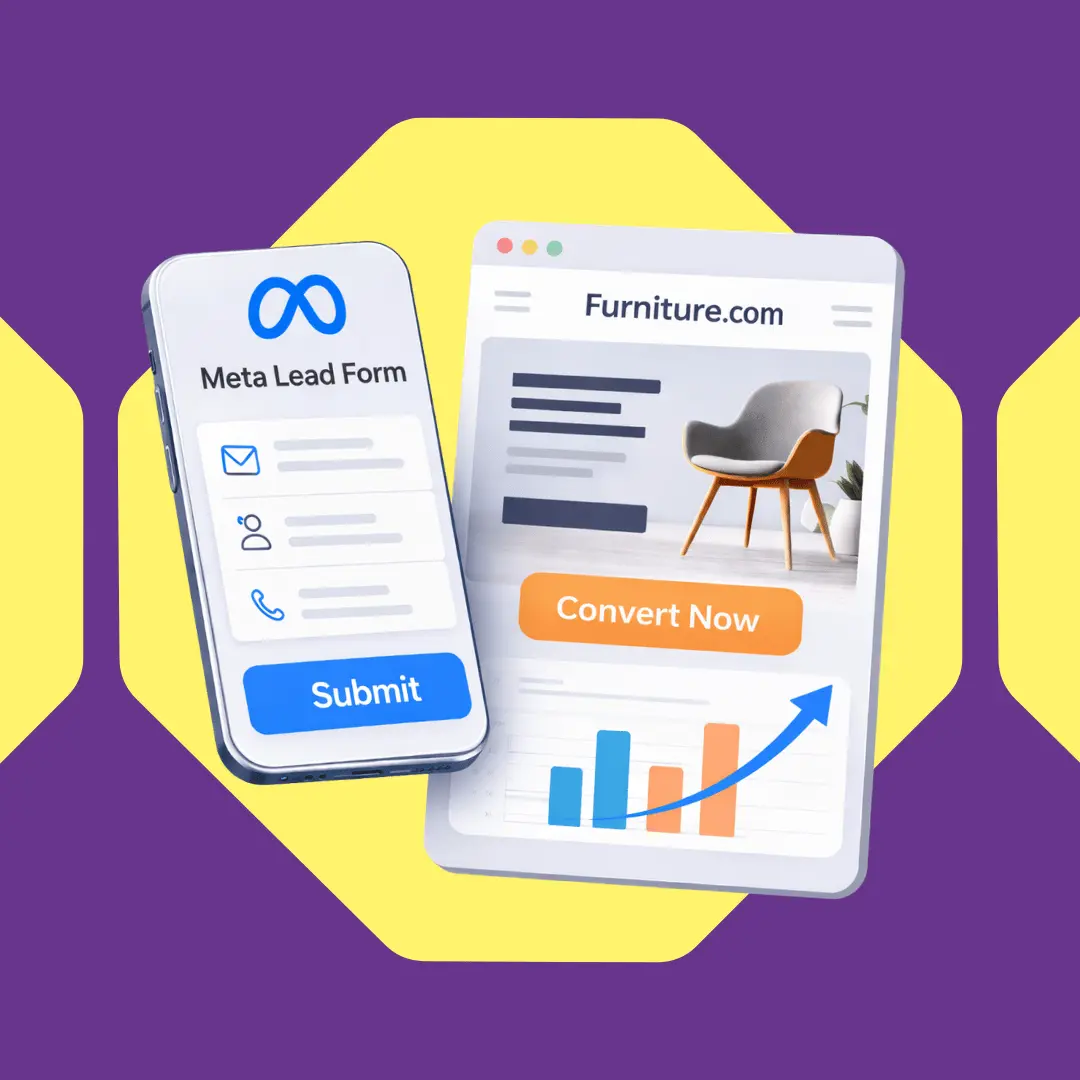
In simple terms, Meta lead forms capture details directly within the platform, while website conversions send users to a landing page on your website to complete their enquiry.
From our experience running paid social campaigns for clients across B2B and B2C, we can confirm that there’s no one-size-fits-all answer. Understanding the differences between these two approaches – and when to use each – can be the difference between high volume or high quality leads.
In this blog, we’ll break down what matters most:
Why CPL vs lead quality matters
Let’s start with a truth most paid media teams will tell you: the cheapest lead is rarely the most valuable. Platforms like Meta are designed to reduce friction in the conversion process, which means lead forms can generate volume quickly. But lower friction also lowers commitment.
When someone can submit their details in two taps without leaving the platform, you often see a higher proportion of casual or low-intent enquiries compared to leads who have taken the time to visit a website and complete a more considered call-to-action.
Sure, Meta lead forms can produce a low cost per lead (CPL). There’s a moment of satisfaction when you see £2, £3, £4 CPLs rolling in, but if those leads go nowhere, you’ve really just paid for data, not results.
The real value isn’t the cheapest lead, it’s the qualified lead. A lead that:
- Has a real need for your service
- Has the budget or authority to buy
- Converts into a customer
If your campaign is optimised purely on CPL, you could be feeding your sales team with low-quality contacts that never convert, which ultimately makes paid media look worse than it actually is. That’s where looking beyond the headline metric becomes essential.
Turning leads into revenue data
One of the most common gaps in early-stage paid media strategies is the absence of a feedback system between campaigns and actual sales outcomes.
Many businesses track leads purely at the point of submission (form fills, calls or enquiries) and report success based on volume alone. However, lead volume does not always correlate with commercial value. If a significant proportion of leads are unqualified, uncontactable or never convert into paying customers, campaign performance can quickly become misleading.
Lead quality isn’t just about the format you choose. How you follow up with leads and track results makes a huge difference to campaign performance.
When does it make sense to use Meta lead forms?
Despite the concerns around lead quality, Meta lead forms can be extremely effective when used in the right context. Because they remove friction from the conversion process, they’re particularly useful when the objective is to capture interest quickly or generate high lead volumes.
They tend to perform well for businesses with strong qualification processes, such as automated follow-ups, call screening or CRM scoring, which efficiently filter out lower-intent enquiries. In these scenarios, the lower CPL can still translate into strong overall acquisition costs once unqualified leads are removed.
Meta lead forms can also work well for:
- Early-stage prospecting campaigns
- Events, downloads or gated content
- High-volume B2C offers
- Brands testing messaging before investing in landing page development
This can be improved by using higher-intent form settings, adding custom qualification questions and introducing review steps before submission.
The key is ensuring that lead capture is only the first step in the process. Without strong follow-up and qualification systems, the benefits of high lead volume can quickly disappear.
When does your ad campaign need dedicated landing pages?
For businesses where lead quality is critical, sending traffic to a dedicated landing page is often the stronger long-term strategy. Website conversions introduce a small amount of friction, but that friction can act as a natural filter for intent.
Landing pages allow you to:
- Provide deeper information about your service or product
- Qualify users through form structure or content
- Track behaviour beyond the form submission
- Optimise the page experience through testing
For higher-value services, complex B2B offerings or considered purchases, this additional context can significantly improve lead quality and downstream conversion rates.
Review your paid media strategy with Trio
In 2026, the question is no longer whether Meta Lead Forms or website conversions are “better.” The real consideration is which model integrates most effectively with your wider marketing and sales systems.
As a performance marketing agency, we help brands optimise both Google ads and social media ads, ensuring campaign performance is measured against revenue impact, not just platform metrics.