Running Riot is our creativity lab – an experimental hub where we can test new ideas and emerging technologies. This time, we are using it to test what AI can actually do when you put it to work on a real project. Can we build a brand and website in 60 days using AI to do all the strategy, design and build?
The aim isn’t to use expensive, expert-level AI platforms. We’re using tools and platforms that are accessible to most people and applying them to the same process we’d use for one of our own website projects.
We are documenting the process as we go on TikTok, Linkedin and Instagram (give us a follow)! We’re looking at what AI can handle, where it speeds things up, where it struggles and, most importantly, where human input is still essential.
We don’t have a set agenda to either discredit AI or alternatively show it can take our jobs. We’re trying to find out how AI performs when taking the lead in developing a marketing strategy and website; something the internet says is easy and cheap to do.
TL;DR
- Running Riot is our creativity lab at Trio, where we test new ideas.
- Our latest experiment is to build a brand and website in 60 days using AI to do the work.
- We’re using accessible and easy to access platforms rather than expensive or specialist tools.
- We’re following our usual website process, which covers branding, sitemap generation, wireframe creation, web design, content writing, web development, go-live and ongoing marketing.
- We’ll measure what works, what doesn’t, how much time AI saves and how much human input is still needed.
- The goal isn’t to prove humans aren’t needed. It’s to understand what happens when AI does more of the work, with a human providing the prompts.
What are we testing in our AI marketing experiment?
We’re asking AI to come up with the marketing strategy, branding, website and ongoing marketing campaign activity for a new business. The narrative around AI is that it can build you a website cheaply and effortlessly. We want to see what actually happens when you try. We’re testing where AI can actually save you time, where it misses the point and where human experience remains essential.
What have we found out so far?
The results so far have been a mixed bag, with lots of frustrations from our team feeling like they could’ve done the job better themselves. We’re using AI for as much of the work as possible, while keeping our team involved to prompt it, check it and make the final calls.
One example where it caused frustrations is we asked AI to help us create a sitemap. What we actually wanted was something practical, an editable table we could move things around in, add to and generally play with. Instead, it created an image of a sitemap with branding and emojis – not really what we wanted and definitely not practical!
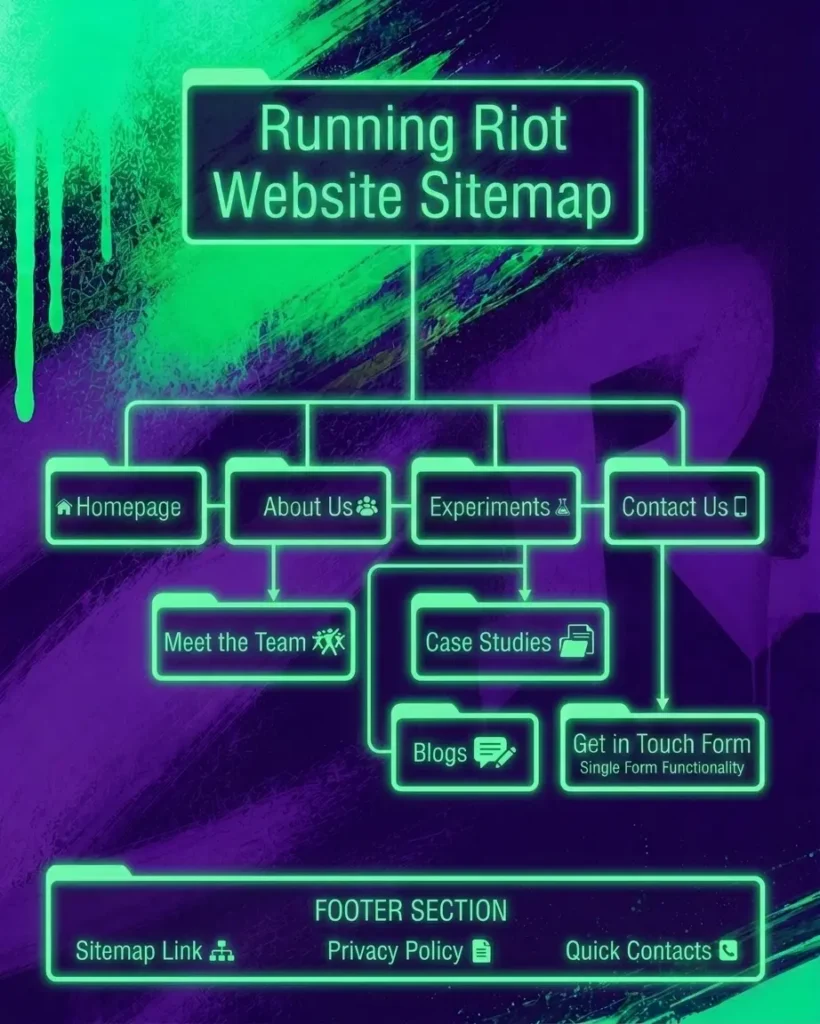
We couldn’t easily edit it or work with it. So we ended up spending more time trying to get AI to create what we actually wanted than it probably would have taken us to make the sitemap ourselves.
We’ve also had some very poor social posts come out of it. The kind of posts that make you think, “There is absolutely no way we’re putting that on our social channels.” They technically answered the brief, but they lacked the tone and design style we’d normally have when designing something ourselves. While the caption generation is generally quick and acceptable, the graphics are much more questionable. We also find that it struggles with consistency across posts, often deviating from fonts and styles when asked to create something new.
There have been a few moments where we’ve gone down an AI rabbit hole, spent ages prompting and correcting something and eventually thought: we could have just done this ourselves by now. This is exactly what Claudia, our Campaign Manager, emphasises when using AI-generated content in your marketing. That’s one of the things we’re finding most interesting: sometimes AI can make a job quicker, sometimes it gives you a really good starting point and other times it actually takes longer than if we’d just done the job ourselves in the first place.
We’ve even had a slightly more stressful lesson in being careful about the tools we’re using. One AI video editing platform offered a “free for 30 days” trial… but then tried to charge us £75. Luckily, the bank declined the transaction as potential fraud. Not quite the free AI platform we thought it would be, and it turns out it can be a very easy mistake to make.
What are we expecting to come out of this?
Our main aim is to understand how our potential clients might be using AI and how good it would be at actually replacing the work we do. We’re not expecting AI to build us a perfect website in 60 days. What we’re hoping to get is a much better understanding of where it’s genuinely useful and how we can use this to guide people who believe they can use AI for their web build instead of a team of experts.
We also want to highlight that you can’t just use AI to build you a website and expect it to perform well straight away. AI can generate something incredibly quickly, give you options and help you get a first draft down in a fraction of the time, but that’s only part of the process.
What’s next?
Next on the timeline is website design. We’ll take the sitemap and wireframes and start turning them into the website’s visual designs. We will be using AI recommendations for the best platform to use, and then reviewing the results.
After that, we’ll move into the content writing and website build. It’s one thing for AI to create a wireframe or suggest some copy but it’s another thing entirely to turn that into a working website that actually looks and behaves how we want it to.
Beyond that, we will get stuck into keyword research and SEO/AEO, looking at what people are searching for and how we can use that to shape the site and its content.
How will performance be measured?
We’re not just going to judge this on whether we manage to launch a website in 60 days. We want to know how we got there.
We’ll be looking at things like:
- Time: Did AI actually make things quicker, or did we spend more time prompting and fixing things than we would have spent doing the work ourselves?
- Quality: Is the output actually good enough? Or does it need so much human intervention that the benefit disappears? When do we trust what AI has produced, and when do we need to check it over?
- Cost: What does it actually cost to do this using accessible AI tools? And are there any nasty surprises along the way?
- Usability: Does AI produce things we can actually work with, or does it give us pretty outputs that aren’t particularly practical?
- The final website: At the end of the 60 days, have we actually built something we’d be happy to launch?
We’ll be honest about the results. If AI saves us hours, we’ll say so. If it produces something brilliant, we’ll show it. If it creates a terrible social post, sends us down a two-hour rabbit hole or tries to take £75 from our bank account, we’ll talk about that too.
Follow our journey
Our Running Riot AI marketing experiment isn’t here to prove that you don’t need AI. Instead, we’re showing what happens when you overrely on AI for all your marketing and where the real experts (humans!) need to step in. These days, people trust AI to do everything, and everything online is telling us it can, so we’re here to test the theory.
Follow along for all the updates on Linkedin, Instagram and TikTok.