ChatGPT ads are where Google Ads was before automation took over: hands-on, limited and still finding their feet. There’s a lot of room to grow, but they’re already giving us valuable insight into how consumer intent is changing.
Consumers are already shifting away from traditional Google search and towards LLMs for their answers. That changes things for us advertisers. Someone asking ChatGPT a detailed question is often further along in their thinking than someone typing a short search. So when ChatGPT ads became available, we wanted to see firsthand what that meant for Trio.
Discover everything we know about this new paid media channel.
TL;DR
- Setup is easy for anyone used to Google or Meta, which means limited control over targeting and strategy.
- Context hints are the only real targeting strategy. Keep them short, varied and written in a way that customers would ask questions.
- We received the right intent but the wrong budgets when we first ran our ads.
- Targeting needs to be 25k+ matched users, but smaller lists still work as exclusions.
- Reporting and competitor visibility are nowhere near other platforms yet.
Getting started with ChatGPT Ads: Simpler than you’d expect
If you’ve run campaigns on Google or Meta, setting up ChatGPT ads will feel easy. It’s a stripped-back version of what you already know. It’s ideal for getting started quickly, but the downside is a lack of control. There are very few options for tailoring campaigns, targeting audiences or building a strategy around specific business goals.
Right now, the main targeting options are context hints. They are set at the ad group level and are something you won’t get right on the first try.
Example content hint: A homeowner or contractor planning a DIY deck building project who needs high-quality, weather-resistant building materials and fast delivery directly to their job site.
What are context hints and why do you need them?
Right now, context hints are essentially your only targeting, so they matter a lot more than the “optional” label suggests. They are used as additional details about your product, service or business that help ChatGPT understand when your ads may be relevant to consumers.
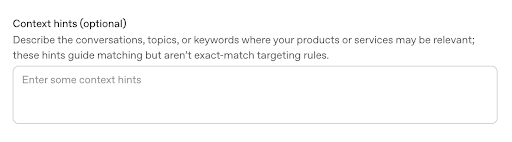
Having written our own context hints and seen the results, we’ve concluded that ours were too long and too specific. Our intention behind writing them this way was to filter out spam and the wrong kind of enquiry, and that did work for us. The leads we received were genuinely looking for the services we offer. The problem was that many of them didn’t have the right budgets.
To gain a better understanding of context hints, we went to Reddit and asked other advertisers who’d been running ChatGPT ads. The advice was all the same:
- Keep hints simple
- Avoid repeating the same wording
- Write them the way a ChatGPT user would actually phrase a question
- ONLY use commas to separate one hint from another
What were the results?
The initial volume was great. We received 20 leads within the first few weeks, from phone calls to form submissions using a decent budget. At the time, this was performing better than Google Ads in terms of lead volume.
The leads were inquiring about the right things (social ads and website builds), but they didn’t have the available budget for an agency. What they wanted to achieve was on a much smaller scale than the work we provide.
So our takeaway was that our intent signals worked, but the targeting isn’t fine-tuned enough to qualify by business size or budget.
How do audiences work in ChatGPT Ads
You can upload audiences to ChatGPT, but to use audiences for targeting and bid adjustments, you need a list of 25,000 matched users. That isn’t as simple as uploading 25,000 emails., These emails need to be linked to a ChatGPT account, and then that user also needs to be using the free version and not a paid model.
For an enterprise brand with a large customer base, that’s possible, but for most small to mid-sized businesses, it’s not very achievable.
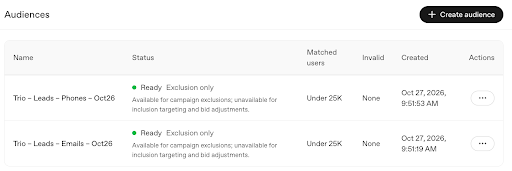
It’s important to note that small lists aren’t completely useless. When we uploaded a list of around 200 contacts, it came back as “Ready – Exclusion only”. So while we couldn’t target them, we could exclude them, which is useful for keeping our ads away from existing clients or filtering out spam leads.
Similar to most platforms, this feels like a beta problem rather than a permanent one. Naturally, the threshold should come down as ChatGPT ads improve, and then audiences could become the most reliable tool available.
What’s missing from ChatGPT ads?
Reporting
Our biggest concern right now, is reporting. Compared with Google Ads or Meta Ads, the data available in ChatGPT ads is limited. The numbers are very top-level, and it’s hard to fully understand why a campaign is performing the way it is.
This makes it difficult to turn results into strategy. When reporting back internally, we could show what happened, but not much about what we can do next. For a paid media team that makes a lot of decisions based on data, it’s not reliable enough yet.
Competitor visibility
Another gap is paid competitor visibility. There’s no official equivalent of Google Ads Transparency Centre or the Meta Ad Library, so it’s hard to see who else in your industry is advertising and what their ads look like. A few third-party tools have started to appear within the space, so there is clearly demand for it.
What are we doing next?
For now, we’ve paused ads to reassess and apply what we have learned.
We will rewrite our context hints from the beginning. Instead of long, highly specific descriptions written the way we might describe our services, we will keep them short, varied and phrased the way a business owner would ask ChatGPT for help, with the goal of showing up in front of people ready to invest in an agency.
We also plan to rebuild a matched list for exclusions, including current clients and any spam inquiries we have received.
Our final thoughts
ChatGPT Ads is good at finding people with the right intent; it’s just not precise enough yet to find the right customers. Given it’s still in beta, advertisers should be considering investing, as long as they accept that a few rubbish leads will come through, as with any advertising platform.
Want your business to show up when customers are asking ChatGPT for answers?
Whether it’s testing ChatGPT Ads or making sure your brand appears in AI-generated answers, we can help optimise your GEO strategy and get you seen where your customers are searching now.
Ready to get started?