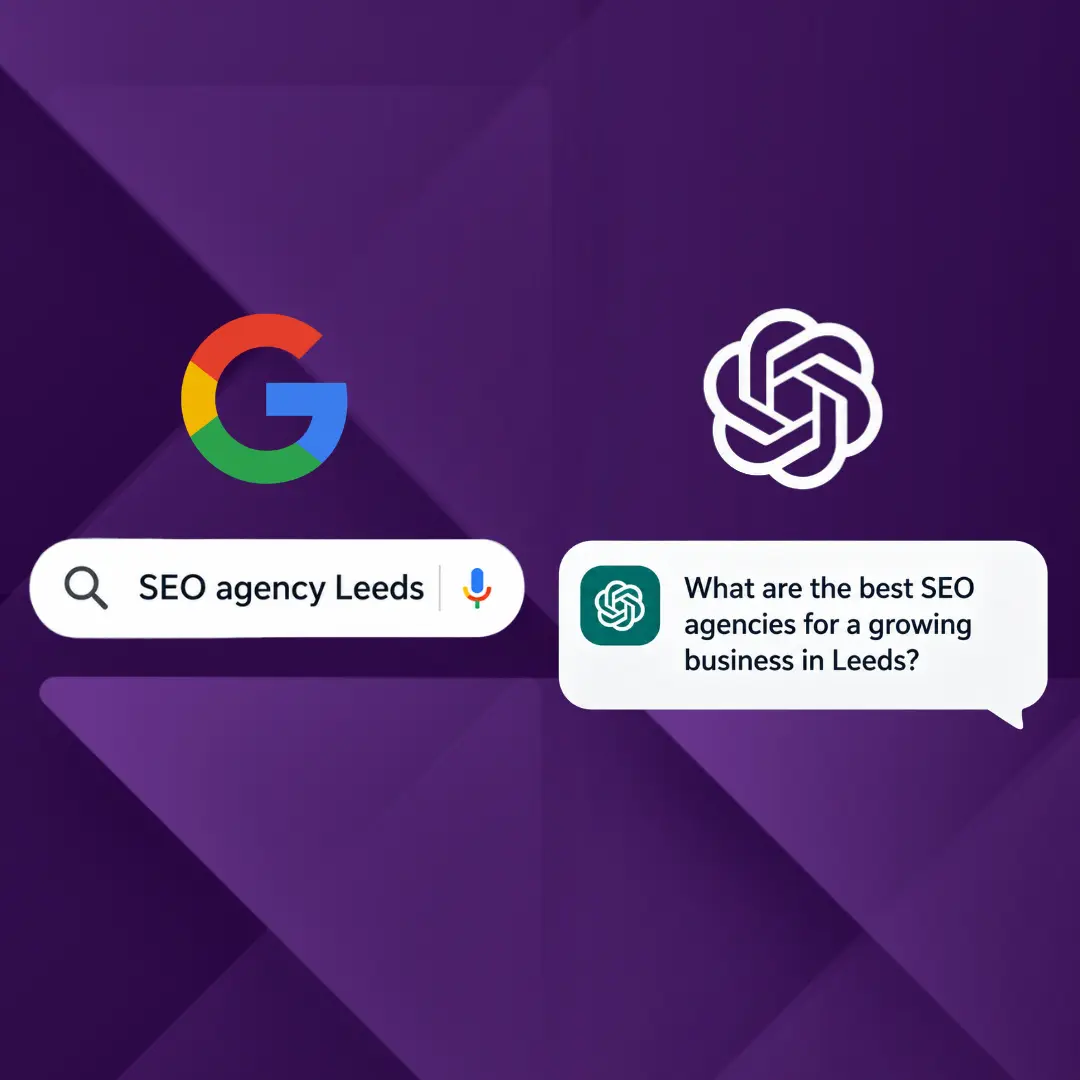

Today’s blog is based on a recent talk we gave on AI & SEO: The Future of Search. We’re looking to address a big challenge in 2025 and beyond – how AI is affecting SEO and what that means for the future.
There’s a lot of confusion currently, as you might have heard the terms AIO/AEO/GEO/SXO /LLMO (spoiler: it’s all the same as SEO) thrown around, but today we’ll demystify everything you need to know about what it really boils down to… online brand discovery.

Our AI journey: How we got here
Over the last two years, I have immersed myself and our agency in the world of AI. In 2024, I attended conferences around the world, seeking to understand how leading organisations were using AI to make smarter decisions or improve efficiency. I went to SXSW in Austin, Texas, the Generative AI Summit in San Francisco, and events closer to home in the UK.
My approach was simple: to survive as an agency, we must learn to thrive in an AI-driven world. Our clients rely on us to be at the cutting edge of marketing and technology, and to help shape their decision-making around marketing.
For me, AI implementation is not about replacing strategic and creative work. It’s about replacing time-intensive, tedious, admin-heavy tasks with a great prompt.
In that vein, we also decided to build our own AI tool. We hired Mahmoud as an AI Engineer, and we’re currently in the stages of building. As I said, I don’t believe AI could, or should, ever replace strategic or creative thinking. The tool we’re developing helps to increase efficiencies during the client/agency briefing process. If it’s a success when completed, it will not only help us but also other agencies.
That’s as much as I’m going to say on that for now! I just wanted to set the tone for how ingrained we are in the world of AI.
Why has AI suddenly become so popular?
You’ll have heard people say, “Artificial Intelligence isn’t new”. And yes, while it has been quietly evolving for decades, something changed in the past few years.
To illustrate what shifted, I asked ChatGPT for its explanation, and here’s what it said:
“We hit a perfect storm: unprecedented computing power, oceans of data, and breakthroughs in language models. And most importantly, interfaces that made AI simple, human, and conversational. Suddenly, you didn’t need to be a data scientist to use AI. You just needed a browser and a question.”
It’s that shift that turned AI from a specialist’s tool into a household name. It wasn’t just the algorithms getting smarter that caused it – the experience was becoming more human. Once the world got hold of it, the momentum became unstoppable. Marketers are right to embrace it.
AI in marketing: Opportunity and overwhelm
When it comes to AI in marketing, I imagine it can be overwhelming for many people. Your experience could range from not using it at all to confusion over which to use, to concerns about security and reliability.
However, we’re here to provide clarity. Clarity over what does require your time and attention, and clarity on the direction we’re all travelling in.
Where are we right now? The state of AI search
Here’s a snapshot of the landscape:
- 400 million weekly active users on ChatGPT as of early 2025.
- 2.5 billion prompts per day globally on ChatGPT.
- Over 100 million monthly active users of Google AI Mode (US & India, still rolling out).
- 2 billion monthly Google users now see AI Overviews in 200+ countries.
- Around 60% of searches now result in zero clicks.
This last number is the big one that leads us to where we are today. The goal posts have changed – less focus on metrics like traffic, and more on visibility and mentions.
However, this isn’t necessarily a new way of working. Marketing has always been about being where your customers are. Discoverability and, more importantly, attention for your brand are at the core of our jobs. So, although the goalposts may have shifted, the goal is still the same… online brand discovery.
The main change is the number of new ways people can discover your brand. For years, Google held a near-monopoly over brand discovery through search. Now, it’s facing competition from AI tools like ChatGPT, Claude and Perplexity.
Google can’t afford to lose this game, because its revenue model depends on attention (and selling real estate on its search engine). The introduction of AI has forced Google to up its game.
Consumer behaviour is driving change with AI in SEO
Traditional Google search queries used to be vague, then we’d get pages of blue links to scroll through and find the answer ourselves. We thought “search” meant using Google’s search functionality, but a more accurate depiction would be that the human was searching, not the engine.
Once a list of results was displayed, we had to search through for the right answer. This is why you’ll hear a lot more about answer engines – as we’re getting a direct answer to our query, often without needing to click. We’ve seen that in the stats: 60% of searches now result in zero clicks.
The fact that consumers are providing better prompts and seeing better results is leading to a change in consumer behaviour.
How AI is changing SEO and consumer behaviour
AI tools are harnessing this change in consumer behaviour, helping you with actions like online shopping without leaving the platform. For example, Shopify has integrated with ChatGPT so that you can check out within the platform and not even visit the online store, and Google’s AI mode can notify you of a price drop on a product you’ve been looking at.
This is why we’re seeing a huge shift in consumer behaviour, and why the term “SEO” is being called into question. Because the pond we were swimming in has suddenly got so much bigger.
For marketers, this is both a dream and a dilemma. Master the art of providing the answer, and you get brand reach and discoverability. Don’t feature at all, and you become nearly invisible. The reality of this is coming into focus now that Google has removed the parameter for reporting the top 100 results for a keyword.
Online brand discovery is everything
In 2025 and beyond, being discoverable means being answerable. If your content can be the answer to someone’s question, you win by gaining attention. Traffic may look different. Clicks may look different. But being visible, being relevant, being authoritative – those all still matter.
Part 2 of this blog will take a look at what our SEO Manager, Darren, recommends you do within your SEO strategy to adapt to the new world of answer engine optimisation.
Fancy reading more on AI & SEO? Your next reads:
Let’s get you found online
Struggling to keep up with the future of AI search? Don’t worry – that’s why you have us! Speak to our team today and we’ll help make sense of it all.