
Search behaviour in 2026 looks completely different to how it did as little as 18 months ago. AI Overviews now sit above paid and organic results on a growing share of Google queries (it’s estimated that 60% of searches now show an AI Overview).
Consumers research products inside AI and social platforms such as ChatGPT, Perplexity, Reddit, TikTok, YouTube and LinkedIn before they ever type a brand name into Google. Generative engines are deciding which sources to cite when answering a customer’s question, and legacy practices of bidding to appear at the top are being outmanoeuvred by AI visibility.
For marketers, the implication is clear: SEO, PPC and AI search discovery can no longer be planned, budgeted or measured in isolation. In this guide, we explain how they now interact, what the data is showing us, and how to build an integrated search strategy that compounds rather than competes.
How has AI changed the SERPs for SEO and PPC?
AI has restructured the search engine results page (SERP) in three significant ways:
- AI Overviews sit at the top. On AI-enabled queries, a generative summary appears above both paid ads and organic listings, often resolving the user’s question without a click.
- Paid results have moved down the page. Sponsored placements that once owned the first scroll now appear below the AI Overview, reducing visibility per click. As an attempt to remedy the reduction in clicks, Google has dialled down how much emphasis it puts on identifying an ad as ‘sponsored’.
- Organic real estate has shrunk. The traditional “ten blue links” model has been compressed, and on many queries, only two or three organic results appear above the fold.
The result is fewer clicks overall, higher competition for the clicks that remain, and a meaningful share of search journeys that never reach a website.
The most influential search statistics in 2026
The shift in user behaviour and platform economics is well documented. The most important data points for 2026 are:
- 60% of Google searches are now zero-click, meaning the user gets the answer within the search engine results page (SERP) and doesn’t progress to visiting a website
- Average CPCs are up 13% year on year, so although search demand is down, this is driving the cost up for advertisers
- Google’s share of voice in the product research process has shrunk from 72% to 55% in 6 months
- Platforms such as Reddit have increased by 80% in the same 6-month period, as a key tool for consumer research
- AI engines’ share of voice has risen from 6% to 18%
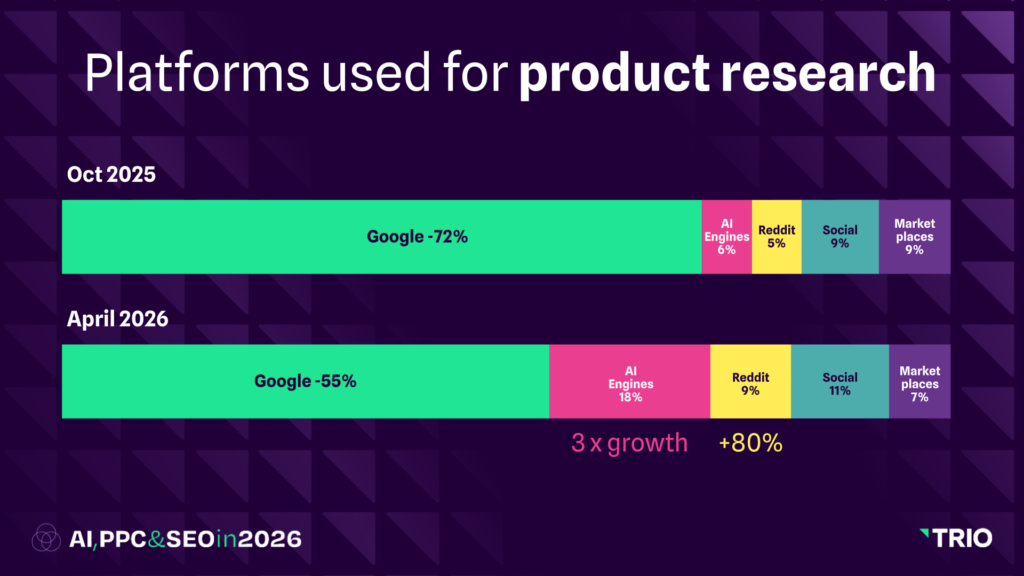
With multiple destinations used to research new products, the search process is fragmented. Marketers must now focus on several channels at once, and it’s no longer just playing to win with Google.
How is AI impacting paid search?
The rise of AI search and the presence of AI Overview above paid results have had a significant impact on paid search. The key changes include:
- Upper-funnel queries are being absorbed by AI Overviews. Informational searches that previously drove ad impressions now resolve on the SERP.
- Click volume is falling while CPCs are rising. Fewer clicks for the same demand means advertisers compete harder for what remains.
- The funnel is narrowing. Customers arrive at Google later in the buying journey, often ready to buy, after researching elsewhere.
- Paid platforms themselves are now AI-led. Google’s Performance Max, Demand Gen 2.0, AI Max and Meta’s Advantage+ Shopping all rely on AI for targeting and optimisation.
The strategic implication is that PPC is more competitive and is no longer about volume; it’s about precision and presence at the moment of intent.
How is AI impacting SEO?
SEO is shifting from a clicks-driven discipline to a citations-driven one. The top changes include:
- Citations within AI answers will become the new #1 ranking. Being cited inside an AI Overview is now often more valuable than ranking organically below it.
- Brand authority and digital PR matter more than ever. AI engines weigh brand mentions, third-party citations and consistent entity signals heavily.
- Structured, scannable content wins. Clear headings, lists, tables and direct answers are easier for LLMs to lift and cite.
The good news is that a well-planned SEO strategy would already be putting emphasis on these key areas, meaning that you not only stay ahead with SEO, but also win those all-important AI mentions in generative search, too.
What is the role of each channel in 2026?
The perfect Trio is to have all search-based specialisms working together. Here’s what that looks like:
- AI has reshaped how consumers research. Placing an emphasis on AI-related searches, with a presence on top-cited platforms like Reddit and LinkedIn, will help marketers win online visibility.
- PPC is the engine for day one visibility. PPC has always offered a more immediate solution to search engine visibility, and that won’t change. However, more paid platforms will come into the mix, with ChatGPT ads launching in the UK in May 2026.
- SEO focuses on long-term visibility. Great quality content, authority and citations are the measure of success, along with a strong technical foundation.
Don’t know where to start?
Review our scenarios below
The right channel mix depends on where your brand is starting from. We’ve listed three scenarios below, depending on your business’s stage.
Scenario 1: New business with limited visibility
If your brand is newer or has limited search presence, the channel mix should focus towards speed of growth and foundation-building. This strategy is the same, not just for new businesses, but for a new domain, product or service, where awareness or visibility is extremely low.
Here’s your three-part strategy to follow:
- PPC: Invest early to drive initial visibility and learnings.
- SEO: Start building now to lay the long-term foundation that reduces future paid dependence.
AEO/GEO: We’ve seen quick wins from being mentioned here early, since most competitors are not yet optimising for AI answers.
Scenario 2: Established business with stable traffic and leads
If your brand already has strong traditional visibility, the priority shifts to defence and incremental growth.
- SEO: Maintains strong category and brand terms, supported by digital PR for domain authority.
- PPC: Targets top-of-funnel queries you can’t capture organically.
AEO/GEO: Builds authority across LLMs, Reddit, LinkedIn, YouTube and TikTok.
Scenario 3: Competitive industry, established brand
In competitive verticals, the integrated mix is about preserving visibility against well-resourced rivals.
- SEO: Maintains top organic positions and brand search dominance.
- PPC: Defends brand terms against competitor bidding.
- AEO/GEO: Provides a competitive edge while rivals are still under-investing.
The keyword decision matrix
Still unsure when each strategy will work best? The table below shows you examples of when you can decide to invest in SEO, AEO/GEO, PPC or all of them together.
| Keyword type | Example | What you see | Recommended decision |
|---|---|---|---|
| Transactional | PPC management London | Rank #2, AI Overview present, not cited | Keep both PPC and SEO |
| Informational | How to reduce PPC costs | Rank #1, cited in AI Overview, low ROAS | Cut PPC, rely on SEO |
| Navigational | [Your brand] reviews | Competitors bidding heavily, you rank #1 | Defend the brand with PPC |
| Commercial | Best B2B CRM 2026 | Rank #6, profitable PPC, AI Overview present | Keep both, accelerate SEO |
The aim of this decision matrix is to ensure that you don’t invest in PPC for search terms that you already dominate organically in search or answer engines.
A three-step workflow for SEO and PPC teams
Implementing an integrated approach does not require new tools; it just requires a shared workflow across your SEO and PPC teams. Here’s an example of how SEO and PPC can collaborate for the most effective results.
- Collect. Merge PPC data (top keywords, CPC, ROAS) and SEO data (rankings, traffic, AI Overview status) into one shared view.
- Compare. Audit overlap. Where are you ranking organically? Where is an AI Overview present? Where is ROAS strong or weak?
- Decide. Make explicit calls to cut PPC where SEO or AI already wins, reduce PPC on low-ROI informational terms, keep both for high-intent conversions, and defend the brand against competitor bidding.
How do SEO and PPC compound over time?
PPC, when run alone, can plateau proportional to spend. SEO, run alone, takes longer to build but eventually delivers more efficient traffic. Run together, the two compounds: PPC accelerates SEO by feeding keyword and conversion insight back, while SEO reduces paid dependence over time.
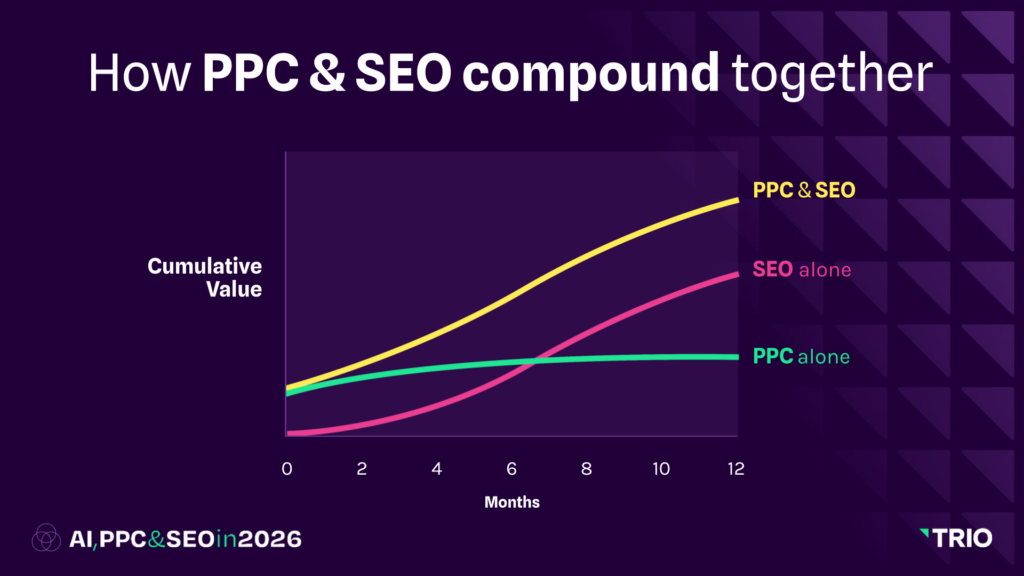
Add AEO into the mix, and the compounding effect strengthens further. AI citations drive brand recognition, over time, brand recognition lowers paid CPCs, and lower CPCs free budget for more SEO investment.
This compounding effect is the single strongest argument for integrating the three.